
What Does It Cost to Build a Custom Home in McAllen?
Custom Home Costs in McAllen: What You Actually Need to Budget
“What do custom home costs in McAllen actually look like?” is one of the first questions families bring to us. It deserves a real answer, not a vague range pulled from a national website. The truth is that what you’ll spend is decided by a series of choices specific to your project, your lot, and your taste. This guide breaks down where the money actually goes so you can plan with real numbers instead of guessing.
Why “Price Per Square Foot” Can Be Misleading

You’ve heard builders throw around a single price-per-square-foot number. It sounds simple, and it’s actually pretty misleading. Think of it like pricing a car by the pound. A luxury sedan and a base-model hatchback weigh about the same, but the price tags couldn’t be more different.
The same thing happens with homes. An 1,800 square foot house with standard finishes costs dramatically less than the same 1,800 square feet finished with custom cabinetry, quartzite counters, and a Control4 smart home system. Price per square foot is a result of all your individual selections, calculated after the fact, not before. Two homes the same size on neighboring lots can be hundreds of thousands of dollars apart based on complexity and material choices. That’s why working with a builder who is transparent about costs matters. We start with your budget and guide your selections to fit inside it.
The Four Buckets of a Custom Home Budget
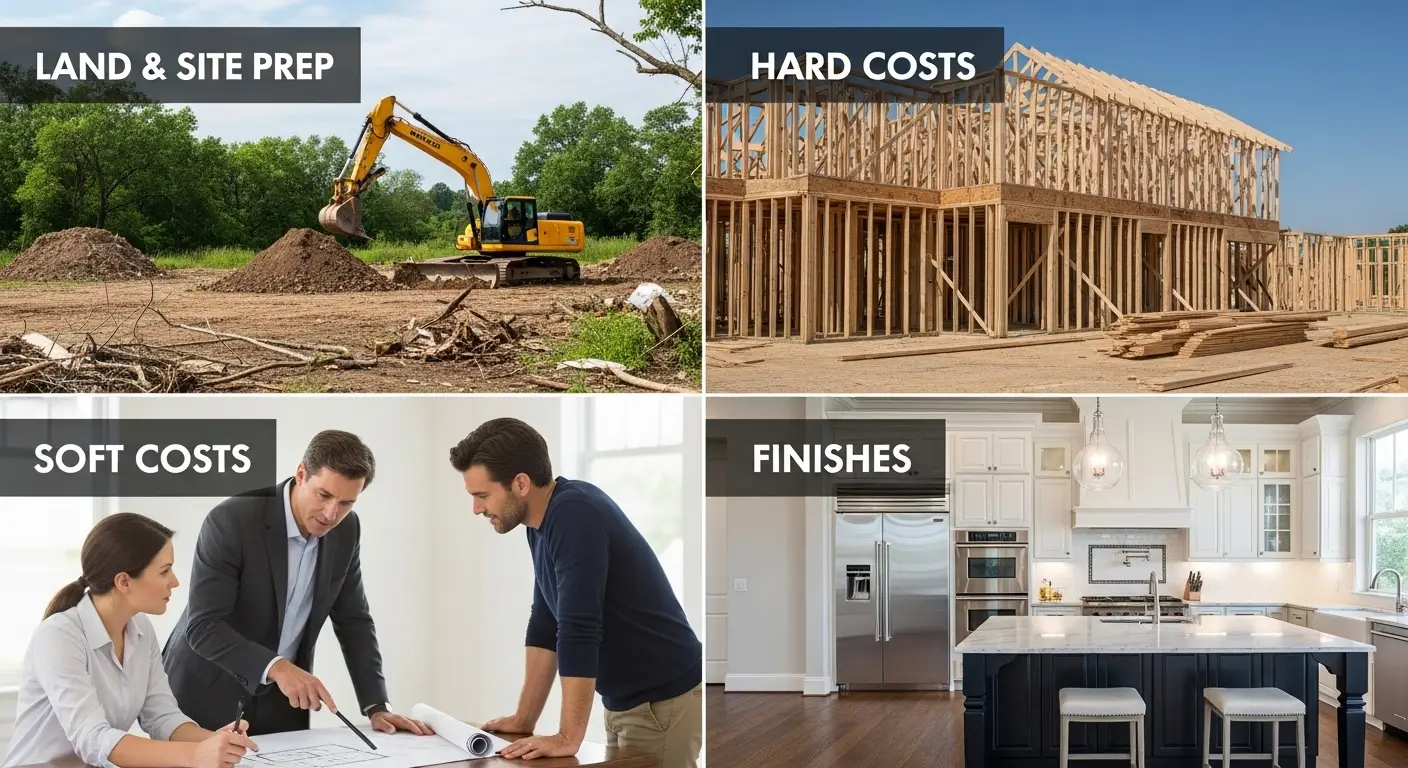
A well-structured budget accounts for every phase of the project. Costs generally fall into four buckets: Land and Site Prep, Hard Costs, Soft Costs, and Finishes.
1. Land and Site Preparation
Before anything gets built, you need a place to build it. If you don’t already own land, the lot purchase is your first major expense. Prices across McAllen and the RGV vary widely by location, size, and neighborhood. Beyond the purchase, budget for clearing, grading for drainage, geotechnical reports, soil treatment, and utility hookups for water, sewer, electric, and gas. These costs swing based on lot condition and they’re where first-time builders most often get blindsided.
2. Hard Costs: The Actual Construction
The biggest chunk of the budget. The sticks and bricks. It covers:
- Foundation (typically post-tension slab-on-grade in the Valley)
- Framing (the wood or steel skeleton)
- Roofing, windows, and exterior doors
- Exterior cladding (brick, stone, stucco)
- Rough-in for electrical, plumbing, and HVAC
- Insulation and drywall
- Labor for all trades
These costs are driven by the home’s square footage, design complexity, and the quality of the base materials.
3. Soft Costs: The Professional Services
The less visible expenses that are absolutely necessary. Design, approvals, and project management:
- Architectural and design fees
- Structural engineering plans
- City or county permits and impact fees
- Land surveys
- HOA review fees (if applicable)
The Texas Association of Builders is a solid reference for statewide standards and best practices that inform much of this category.
4. Finishes and Fixtures: Where Your Style Shows Up
The category with the biggest range. Flooring can be affordable luxury vinyl plank or imported large-format porcelain. Countertops can be laminate or quartzite. The choices are yours and they add up fast. This category covers:
- Interior and exterior paint
- Flooring (tile, wood, carpet)
- Cabinetry and countertops
- Plumbing fixtures (faucets, sinks, toilets)
- Lighting fixtures
- Appliances
- Trim, molding, and interior doors
- Landscaping and irrigation
- Driveways, patios, and outdoor living spaces
What Actually Drives the Final Number

Beyond the four buckets, a few key decisions move the budget the most:
Size and complexity. Bigger costs more, but complexity matters just as much. A simple one-story rectangle is cheaper to build per square foot than a two-story home with multiple rooflines, vaulted ceilings, and structural cantilevers. Open-concept layouts often require engineered beams to span long distances without columns. Every corner, every angle, every architectural detail adds cost in materials and in labor hours.
Quality of materials. This goes beyond finishes. Impact-rated windows for storm protection or standing-seam metal roofing instead of asphalt shingles raises the upfront number significantly. Same with custom cabinetry over semi-custom, professional-grade appliances over builder-grade. You get what you pay for. The skill is knowing where to invest and where to hold the line without sacrificing quality.
Energy efficiency. Building a high-performance home costs more upfront and pays back every month for the life of the home. Closed-cell spray foam insulation, properly sized variable-speed HVAC, tankless or hybrid heat-pump water heaters, and Low-E argon windows all add to the initial budget. In a market where summer AC bills are punishing, these features can shave hundreds off the monthly cost and keep the house comfortable year-round.
How We Handle Budgeting at Sisu Development

The financial side of building can feel overwhelming, and it doesn’t have to be a guessing game. Here’s how we approach it.
It starts with a real conversation about your vision, your needs, and what you want to invest. We don’t throw out a per-square-foot number and hope for the best. Because our design team and construction team work together from day one through our building process, we can design a home that’s beautiful, functional, and aligned with your budget before we ever break ground. As we move through design and selections, you get detailed line-item estimates so you can see exactly where every dollar goes. No surprises at draw three, no hidden fees at closing.
Ready to Start Planning?
Understanding custom home costs in McAllen is the first real step in a build. The final number is a sum of many parts, from the dirt and the labor through to the faucets and flooring. It’s a series of informed decisions you make alongside your builder.
If you’re ready to start exploring what’s possible, take a look at our recent projects for examples. Then reach out and we’ll sit down, walk through what you’re looking for, and give you a real sense of what your project would cost.
Building in the Valley?
Let’s talk.
Daniel runs every Sisu build personally and answers his own phone. Schedule a call, send a note, or just ask a question.